Should I do a Roth conversion to reduce future RMDs?
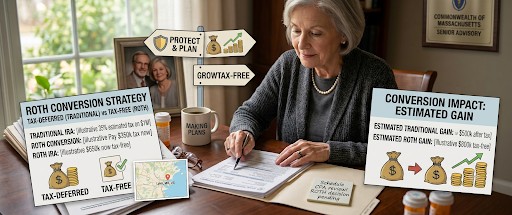
Roth IRAs have no RMDs during the original owner's lifetime. Every dollar you convert from a Traditional IRA to a Roth is a dollar that will never generate a future required distribution — but the conversion itself is a taxable event in the year you do it. The strategy question isn't whether to convert, it's how much and when.
Why timing is everything
The classic window for Roth conversions is the gap between retirement and when Social Security and RMDs begin — often your lowest-income years. Converting into that gap means paying tax at a lower marginal rate than you might face later once RMDs, Social Security, and possibly IRMAA surcharges are all layered on top of each other.
Risk of over-converting
- Pushes you into a higher tax bracket in the conversion year
- Can trigger Medicare IRMAA surcharges two years later
- May increase how much of your Social Security is taxable
Bracket-filling conversions
- Convert just enough to "fill up" your current tax bracket
- Repeat annually across several years, not all at once
- Reassess each year based on other income changes
Ideal conversion years
- After retiring, before Social Security starts
- Years with unusually low income (e.g., a gap year)
- Before RMDs begin, while you still control your income level
The IRMAA lookback trap. Medicare premiums are based on your income from two years prior. A large conversion this year can quietly increase your Medicare premiums two years from now — model this before converting a large amount.
The five-year rule
Each Roth conversion has its own five-year clock before the converted amount can be withdrawn penalty-free if you're under 59½ (earnings have separate rules). This mainly matters if you might need the converted funds early — for most people converting in their 60s planning to leave the money invested, it's a smaller concern than the tax-bracket math.
Beyond lowering future RMDs, Roth conversions also mean tax-free growth going forward and tax-free inheritance for your heirs — benefits that compound the earlier you convert, assuming the current-year tax cost makes sense.
Get help mapping the right conversion amount
A fiduciary financial advisor can run your specific numbers against current tax brackets and IRMAA thresholds before you convert.
Common questions
Do I need earned income to do a Roth conversion?
No — unlike a Roth contribution, a conversion isn't limited by earned income or annual contribution limits. You can convert any amount from an eligible Traditional account.
Can I undo a Roth conversion if I change my mind?
No — the "recharacterization" option that used to allow this was eliminated. Conversions are final for the tax year they're made, so it's worth modeling carefully before converting a large amount.
Does converting affect my RMD for the year I convert?
You must take your RMD for the year before converting any additional funds — the RMD amount itself cannot be converted.