
Tax Strategy
Qualified Charitable Distributions
Send your RMD directly to charity and it never counts as taxable income — a bigger benefit than a normal donation.
Read guideOnce you hit 73, the IRS requires you to withdraw a minimum amount from your retirement accounts each year — whether you need the money or not. Miss the deadline and you owe a 25% penalty on what you should have taken.
Enter your account balance and age to calculate your exact required minimum distribution for 2026. Supports IRAs, 401(k)s, 403(b)s, and inherited accounts. Results in seconds.
Calculate My 2026 RMDAlready used this and other tools? See it all together in your Snapshot →
RMD rules have changed significantly over the past few years — SECURE Act (2019) and SECURE 2.0 Act (2022) both pushed back the starting age and changed inherited account rules. What applied to your parents may not apply to you.
If you were born between 1951 and 1959, your required beginning date is April 1 of the year after you turn 73. SECURE 2.0 (2022) moved the age from 72 to 73 for this group.
SECURE 2.0 scheduled a further push to age 75 for anyone born in 1960 or later. If you're in this group, you have more years to grow tax-deferred before distributions are required.
If you're still employed and participating in your current employer's 401(k), you may be able to delay RMDs from that specific account until you retire — even past the starting age. IRAs and old 401(k)s from previous employers don't qualify for this exception.
| Account Type | RMD Required? | Notes |
|---|---|---|
| Traditional IRA | Yes | RMDs required annually starting at your applicable age (73 or 75) |
| SEP IRA | Yes | Treated same as Traditional IRA for RMD purposes |
| SIMPLE IRA | Yes | Same rules as Traditional IRA |
| 401(k) | Yes | RMDs required unless still working for the sponsoring employer |
| 403(b) | Yes | Same rules as 401(k). Pre-1987 balances have special rules |
| 457(b) | Yes | Governmental 457(b) plans follow standard RMD rules |
| Roth IRA | No | No RMDs during the owner's lifetime — key planning advantage |
| Roth 401(k) / Roth 403(b) | No | SECURE 2.0 eliminated RMDs from Roth 401(k)s starting 2024 |
| Inherited IRA (spouse) | Yes | Spouse beneficiaries have options — can treat as own IRA or defer |
| Inherited IRA (non-spouse) | Yes | 10-year rule applies; must deplete by end of year 10 post-inheritance |
Roth 401(k) RMD rules changed in 2024. Before SECURE 2.0, Roth 401(k) accounts were subject to RMDs — a significant planning disadvantage versus Roth IRAs. Starting in 2024, Roth 401(k) accounts are RMD-free during the owner's lifetime, matching Roth IRA rules. If you were taking RMDs from a Roth 401(k), verify with your plan administrator that they've updated their distributions.
Send your RMD directly to charity and it never counts as taxable income — a bigger benefit than a normal donation.
Read guide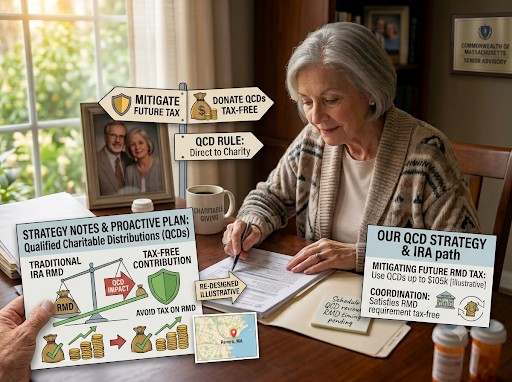
Pay tax now to shrink or eliminate future RMDs entirely — but timing determines whether this actually saves you money.
Read guide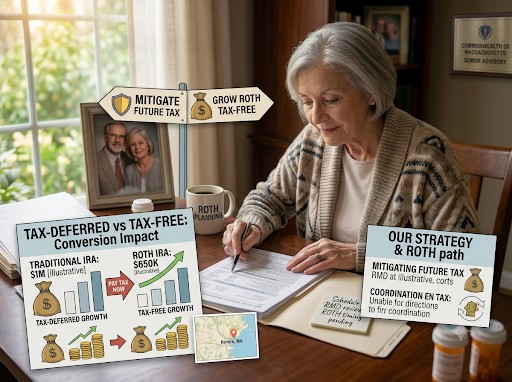
Uses the IRS Uniform Lifetime Table to calculate your exact RMD for traditional IRAs, 401(k)s, and inherited accounts.
Calculate my RMD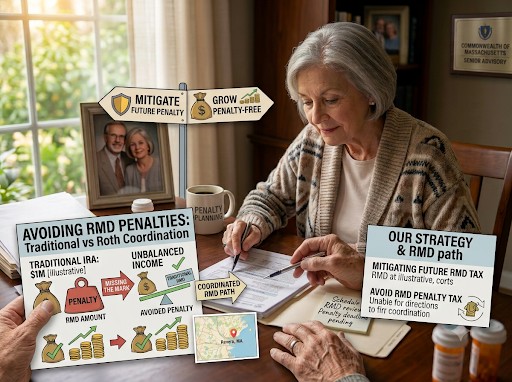
The penalty for missing an RMD dropped from 50% to 25% under SECURE 2.0 — and can fall to 10% if corrected quickly. Here's how to fix a missed RMD.
Read guide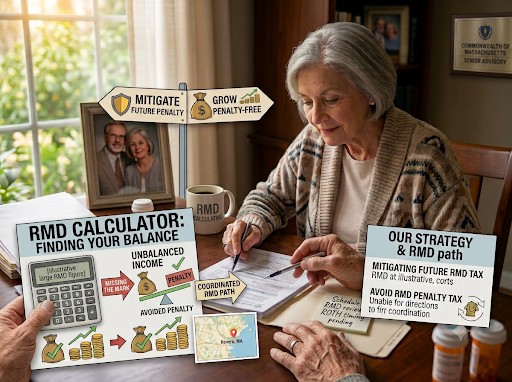
RMDs are ordinary income. Large distributions can push you into a higher bracket, trigger Medicare surcharges, and make more of your SS taxable. Here's how to plan around it.
Read guideQualified Charitable Distributions (QCDs) let you satisfy an RMD without paying income tax on it. If you're 70½ or older, you can direct up to $111,000 per year (2026) directly from your IRA to a qualified charity. The amount counts toward your RMD but is excluded from your taxable income — a meaningful strategy if you're charitably inclined.
SECURE 2.0 made big changes, and more IRS guidance is expected. Get RMD updates, deadline reminders, and retirement tax strategies every Tuesday — free.
No spam. Unsubscribe anytime.
Start with the topic that matters most, or explore our free retirement tools.