 Written and reviewed by the SavedNest Editorial Team · See how we source and verify this
Original Medicare doesn't. Several other programs sometimes do. Here's where to look, what to ask, and what each one usually requires.
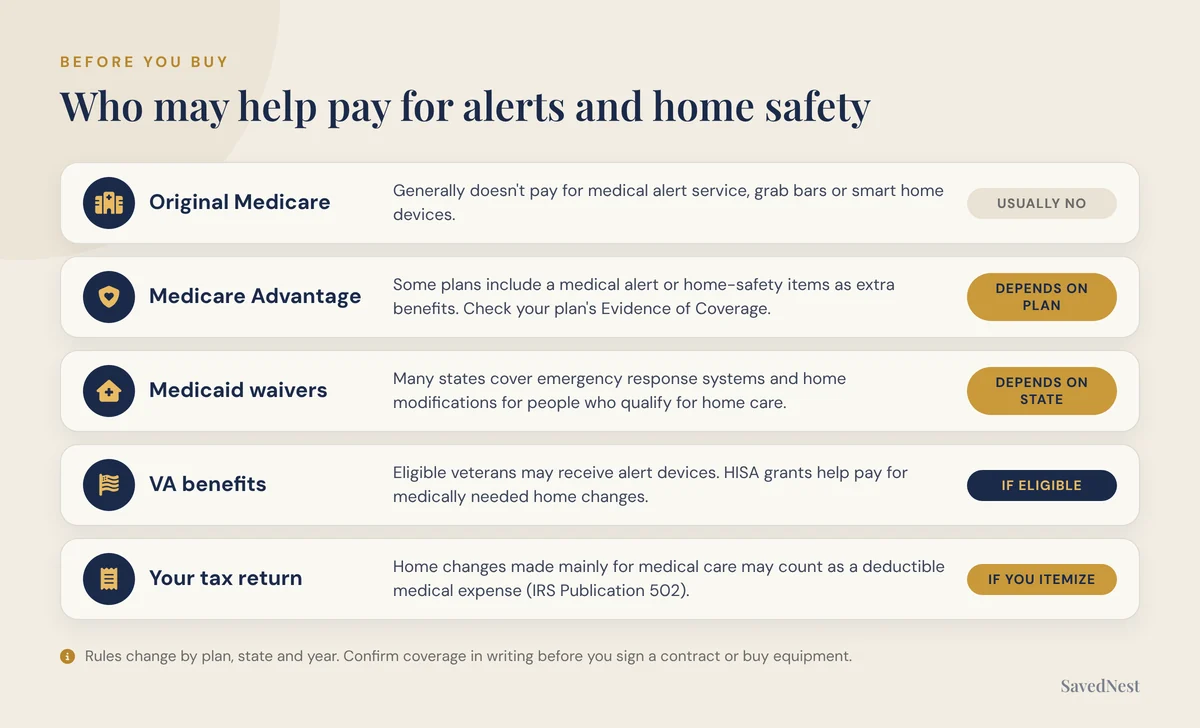
Medical alert systems aren't covered under Part A or Part B, including the equipment, the monitoring subscription and fall detection. A Medigap policy won't help either, because Medigap only fills gaps in what Original Medicare already covers.
Medicare Advantage plans can offer extra benefits beyond Original Medicare, and some include a medical alert (often called a personal emergency response system, or PERS). Coverage ranges from a discount to the full monthly cost, and some plans require a medical reason or a doctor's note.
If the plan covers it, you usually have to use the provider the plan contracts with. Ask about fall detection and mobile coverage, since covered devices are sometimes the basic in-home model.
Regular Medicaid generally doesn't pay for a medical alert on its own. The coverage sits in Medicaid's home and community-based services (HCBS) programs, often called waivers, which help people who need long-term care stay at home. A federal advisory commission found that as of 2025, every state but one covers personal emergency response systems in at least one of these adult programs (counting Washington, D.C. as a state).
See how Medicaid waivers work and your state's long-term care guide.
A 2020 VA rule removed an old restriction on medical alert devices. A VA clinician can now prescribe one when it's a direct part of treating or rehabilitating a veteran's condition. It isn't automatic, and the VA won't provide a device purely for monitoring or convenience.
The first step is to raise it with the veteran's VA primary care provider. Home changes are a separate benefit: the VA's HISA grants can help pay for medically needed modifications such as bathroom changes. TRICARE does not cover medical alert systems.
Paying privately, a basic in-home system runs about $275 to $485 a year in 2026. Mobile plans cost more. See our comparison of types, costs and contract terms.
No. Original Medicare (Parts A and B) does not pay for medical alert equipment or monitoring.
Some do, as an extra benefit. Coverage depends on the plan and may require a medical reason. Check the plan's Evidence of Coverage or call member services and ask about a personal emergency response system (PERS).
Regular Medicaid usually does not, but almost every state covers personal emergency response systems in at least one home and community-based services program for adults. You generally need to be enrolled in that program, and some have waitlists.
Sometimes. Since a 2020 rule change, a VA clinician can prescribe a medical alert device when it is part of treating a veteran's condition. It is decided case by case, so start with the veteran's VA primary care provider.
Many medical alert systems qualify as eligible expenses, according to NCOA. Check with your plan administrator before you buy.
Start with the topic that matters most, or explore our free retirement tools.