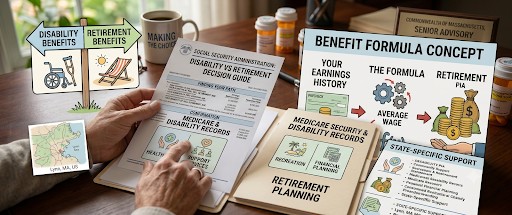
Should I apply for SSDI, or just claim retirement benefits early?
Social Security Disability Insurance (SSDI) and Social Security retirement benefits are both paid from the same trust fund and calculated using the same basic formula — your Average Indexed Monthly Earnings (AIME). But they're not interchangeable, and choosing wrong can cost you a permanent reduction you didn't need to take.
The core difference
Retirement benefits are reduced for every month you claim before your Full Retirement Age (FRA) — as early as 62, at a permanent reduction of up to 30%. SSDI benefits are not reduced for age. If you qualify for SSDI, you receive the same monthly amount you'd get at full retirement age, regardless of how old you are when you're approved.
The costly mistake: Filing for early retirement at 62 because you can't work, when you may have actually qualified for SSDI at your full, unreduced rate. Once you've locked in the early-retirement reduction, it generally cannot be undone.
Who qualifies for SSDI
SSDI has two tests, both of which must be met:
Work credits (the "insured" test)
Generally, you need 40 work credits, 20 of which were earned in the last 10 years before you became disabled — though the exact number is lower if you become disabled at a younger age.
Medical severity test
SSA's definition is strict: your condition must prevent you from doing substantial work, is expected to last at least 12 months or result in death, and you must not currently be doing "substantial gainful activity" (a specific earnings threshold SSA updates annually).
SSDI vs. early retirement, side by side
| SSDI | Early Retirement (62–66) | |
|---|---|---|
| Monthly amount | Full, unreduced rate | Reduced up to 30% |
| Reduction is permanent? | No reduction to begin with | Yes — even after reaching FRA |
| Approval timeline | Often 3–7 months; longer on appeal | Weeks |
| Medical proof required | Extensive documentation | None |
| Converts to retirement benefit | Automatically at FRA, same amount | N/A — already retirement |
If you're approved for SSDI, it automatically converts to a retirement benefit at your full retirement age — at the exact same amount. You never take the early-claiming hit.
When early retirement is still the right call
SSDI isn't always faster or better. If your condition doesn't meet SSA's strict disability definition, or you need income now and can't wait out an SSDI application (which can take months, and is denied on first application more often than it's approved), early retirement is the reliable fallback. You can also apply for both simultaneously in many cases — SSA will pay retirement benefits while your disability claim is pending, and adjust once it's decided.
Not sure which path fits your situation?
A fiduciary financial advisor can walk through your specific work history, medical situation, and timeline — free to talk to, no obligation.
Common questions
Can I apply for both SSDI and retirement at the same time?
Yes. Many people file for reduced early retirement to have income while their SSDI claim is under review, since SSDI decisions can take several months. If SSDI is later approved, SSA adjusts your payments to the higher SSDI rate going forward.
What happens to my SSDI at full retirement age?
It automatically converts to a retirement benefit at the same dollar amount — no application needed, no reduction applied.
How long does SSDI approval typically take?
Initial decisions often take 3–7 months. If denied and appealed, the process can extend well over a year. Roughly two-thirds of initial applications are denied, with many approved later on appeal.