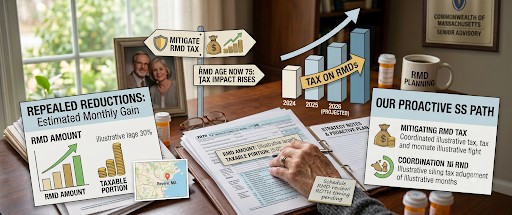
RMDs are taxed as ordinary income — and their impact goes well beyond just the tax on the distribution itself. Large RMDs can trigger a chain reaction that affects three other major costs.
Effect 1 — Federal Income Tax Bracket
RMDs add to your adjusted gross income and can push you from a lower bracket into a higher one. Even a modest RMD can be significant when combined with Social Security income, pension income, or investment distributions.
For a married couple, the difference between the 12% and 22% federal bracket in 2026 is roughly $89,075. A $20,000 RMD that pushes you over that threshold means paying 22% on the excess instead of 12% — an additional 10 cents on every extra dollar.
Effect 2 — Social Security Taxability
RMDs count toward your "combined income" calculation, which determines what percentage of your Social Security benefit is taxable. RMDs can push combined income above the $32,000 threshold (joint) and make up to 85% of your SS benefit taxable — when it might have been 0% or 50% without the RMD.
Effect 3 — Medicare IRMAA Surcharges
Medicare Part B and Part D premiums are based on your MAGI from two years ago. A large RMD in 2026 will affect your 2028 Medicare premiums. For married couples filing jointly, IRMAA surcharges begin at $212,000 MAGI (2026). A single large RMD can trigger these surcharges unexpectedly.
| 2026 MAGI (Married Joint) | Part B Monthly Surcharge |
|---|---|
| $212,000 or below | $0 (standard premium only) |
| $212,001–$266,000 | +$69.90/mo per person |
| $266,001–$334,000 | +$174.70/mo per person |
Model Your Full Tax Picture
The Retirement Tax Estimator shows how your RMD interacts with SS, brackets, and IRMAA together.